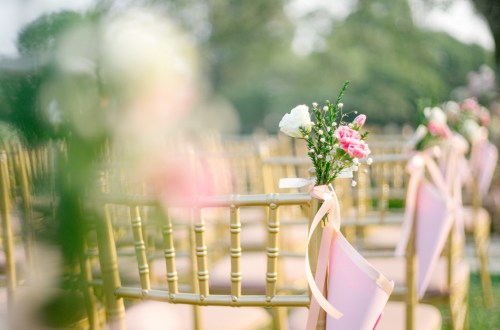
10 Budget-Friendly Wedding Hacks That Can Actually Save You Money

Weddings have a sneaky way of turning small expenses into very large numbers.
It’s only $4 per chair.
Until you need 120 chairs.
It’s only $8 more per centerpiece.
Until there are 15 tables.
And suddenly you’re looking at your wedding budget wondering how napkins became a financial decision.
The good news is that you don’t have to cut everything you love to bring wedding costs under control. Often, the biggest savings come from being strategic about where you spend rather than trying to make every part of the wedding as cheap as possible.
Here are 10 realistic wedding hacks that can help you save money without making your celebration feel budget.
1. DIY Simple Flower Arrangements
This post contains affiliate links. As an Amazon Associate I earn from qualifying purchases.
Flowers can become expensive quickly, particularly when you’re paying for elaborate arrangements on every table.
If you enjoy arranging flowers, consider DIYing the simpler pieces.
Buy seasonal flowers from a local flower market, florist, wholesaler, or even supermarket and use them for bud vases, cocktail tables, or uncomplicated centerpieces.
You don’t need enormous arrangements to make a table look beautiful. A few flowers in small vases mixed with candles and greenery can have just as much impact.
Practice beforehand, keep the designs simple, and recruit a few reliable helpers.
And unless you’re very confident with flowers, consider leaving complicated installations and your bridal bouquet to a professional.
2. Consider a Pre-Owned or Rental Wedding Dress
Your wedding dress doesn’t necessarily have to be brand new.
Pre-owned gowns can offer significant savings, particularly when the original bride wore the dress once for a few hours.
You may also find bridal boutiques or rental services offering gowns for a fraction of the cost of purchasing one.
Just remember to include alterations, cleaning, shipping, and accessories when comparing prices.
A $500 gown that requires $700 worth of alterations isn’t really a $500 gown.
Shop based on the final cost, not just the number on the tag.
3. Hold the Ceremony and Reception in One Place
One venue can simplify both your wedding day and your budget.
When your ceremony and reception happen at the same location, you may be able to reduce transportation expenses, additional venue charges, delivery complications, and the amount of décor required.
It’s also easier for guests.
Nobody has to leave the ceremony, figure out directions, find parking again, and wonder whether they’re supposed to arrive at the reception immediately or in an hour.
Look for venues with multiple spaces—a garden for the ceremony and an indoor room for the reception, for example.
One location. Two different atmospheres.
4. Ask About Off-Peak Wedding Dates
Saturday evening is prime wedding territory.
And prices may reflect that.
Ask venues and vendors whether their rates change for Fridays, Sundays, weekdays, mornings, afternoons, or less popular months.
Don’t assume you’ll automatically receive a discount. Some venues charge the same regardless of the day.
But it’s absolutely worth asking.
If your guest list can comfortably attend on an alternative date, you may discover better availability or packages than you’d find for a peak-season Saturday.
Just consider your guests before booking a Tuesday afternoon wedding because the venue was half price.
Saving money is wonderful.
Having everyone use a vacation day to attend your ceremony may be less wonderful.
5. Put the Extra Information on Your Wedding Website
Not every piece of wedding information needs its own beautifully printed card.
Use your wedding website for accommodation details, directions, transportation information, FAQs, registry links, dress-code explanations, schedules, and other updates.
You can even collect RSVPs online if that works for your guest list.
Then keep your printed invitation suite simple.
Fewer inserts can mean less printing and potentially lower postage costs while giving guests one convenient place to find information.
And when something changes?
You update a webpage instead of discovering you have 80 beautifully printed cards containing the wrong shuttle time.
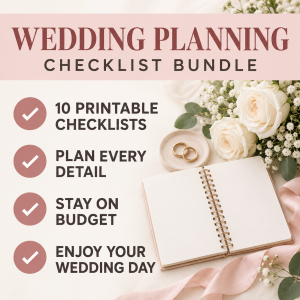
Planning your wedding? Keep all those little details from becoming overwhelming with 10 printable checklists covering your timeline, budget, venue, vendors, guests, attire, décor, photography, wedding day and more.
6. Simplify Your Centerpieces
Wedding centerpieces don’t have to be enormous floral installations.
Candles, bud vases, greenery, framed photographs, lanterns, potted plants, or a combination of smaller elements can create beautiful tables.
The trick is repetition.
A simple centerpiece repeated consistently across the room can look intentional and elegant.
Before buying décor, check what your venue already provides. You may discover they have candle holders, table numbers, vases, easels, or other pieces available for couples to use.
There’s no sense buying 15 lanterns when 15 perfectly good lanterns are already sitting in the venue’s storage room.
Reusable acrylic table numbers give reception tables a polished, coordinated look and can often be resold or passed to another couple afterward.
7. Compare Alternative Catering Styles
A traditional plated dinner isn’t your only choice.
Depending on your venue and caterer, buffets, family-style meals, brunch menus, food stations, barbecue, pizza, or food trucks may offer different price points.
But don’t assume casual food automatically means cheap food.
Food trucks may have minimum spending requirements, travel fees, staffing costs, or limitations on how quickly they can serve a large guest list.
Ask for the complete cost of each option—including service staff, rentals, gratuities, setup, and cleanup—before deciding which one actually saves money.
Sometimes the least expensive option isn’t the one you expected.
8. Borrow Before You Buy
Before ordering wedding décor, ask around.
Recently married friends and relatives may have boxes filled with candle holders, easels, table-number frames, baskets, signs, string lights, vases, and other wedding supplies they would be delighted to get out of their houses.
You can also check local wedding resale groups or marketplaces for items other couples no longer need.
Wedding décor has an unusually short career.
It works one Saturday and then spends three years living in somebody’s closet.
Give it another job.
9. Make Your Ceremony Flowers Work Twice
If you’re paying for beautiful flowers, get as much use from them as possible.
Large ceremony arrangements may be moved to the reception entrance, sweetheart table, bar, or another focal point after the ceremony.
Bridesmaids’ bouquets can be placed in waiting vases and used as reception décor.
Even aisle arrangements may be reusable depending on their design.
Discuss this with your florist and coordinator beforehand.
You’ll need someone responsible for moving everything while you’re taking photographs—not a bride in a wedding dress sprinting across the venue carrying an urn of hydrangeas.
A coordinated bulk artificial flower set can lower décor costs and lets you assemble arrangements early instead of paying rush prices during wedding week.
10. Design Your Own Invitations
You don’t need to hire a stationery designer to have beautiful wedding invitations.
Customizable templates make it possible to create a simple, polished invitation suite yourself and have it printed professionally.
Choose a clean design, limit yourself to one or two fonts, and avoid adding unnecessary inserts.
Before printing the full order, print one complete sample at actual size.
Then check:
Names.
Date.
Time.
Address.
Spelling.
Website.
Everything.
And give it to someone else to proofread before you hit “order.”
Because saving $300 on stationery loses some of its charm when you have to print all 100 invitations twice.
Decide What Matters Before You Start Cutting
The best wedding budget isn’t necessarily the smallest one.
It’s the budget that puts your money toward the things you actually care about.
If photography matters enormously to you, hire the photographer you love and simplify the centerpieces.
If food is important, spend more on dinner and skip expensive favors.
If you’ve dreamed about a particular venue for years, perhaps that’s your splurge and you buy a pre-owned dress.
You don’t need the premium version of every single wedding detail.
Choose a few things worth spending on, save aggressively on the things you don’t care about, and completely eliminate the things you’re only buying because weddings are “supposed” to have them.
That’s how you create a beautiful wedding without paying for a hundred things that didn’t matter to you in the first place.
Want a little help keeping all those wedding details organized? The Wedding Planning Checklist Bundle is there when you’re ready, with 10 printable checklists to help you plan your big day one checkmark at a time.
Practical Extras That Support These Ideas
The right tools should support the advice—not interrupt it. These practical options connect directly to the ideas above and can make them easier to use in real life.
For budget, a Adjustable wedding backdrop stand can give fabric, flowers or signs a secure structure for a polished display.
Helpful Wedding Products

You May Also Like

10 Tips to Help You Have a Beautiful Budget Wedding

10 Common Wedding Planning Mistakes and How to Avoid Them